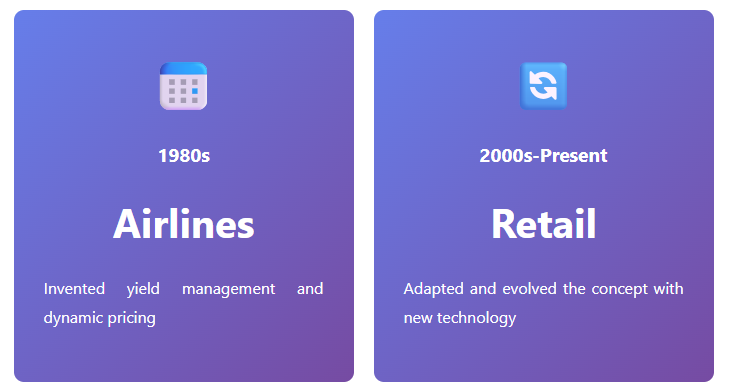
For decades, airlines have been pioneers in revenue management and dynamic pricing. The industry invented yield management in the 1980s, creating sophisticated algorithms that adjust prices based on demand forecasts, booking curves, and capacity constraints. Yet despite this legacy of innovation, there’s an uncomfortable truth: retail pricing teams have quietly surpassed airlines in several critical areas of pricing strategy and execution.
This isn’t about abandoning the fundamentals that have served aviation well. Rather, it’s about recognizing that the retail sector has evolved pricing capabilities that airline revenue management teams can adapt and integrate into their own operations. The convergence of technology, data availability, and changing customer expectations has created an opportunity for airlines to reimagine their approach by borrowing best practices from their retail counterparts.
To appreciate where airlines stand today, we must first acknowledge their revolutionary role in creating dynamic pricing as we know it. The story begins in 1978 with the Airline Deregulation Act in the United States, which removed government control over routes and fares. This sudden freedom created both opportunity and chaos—airlines could now set their own prices, but they also faced unprecedented competition.
The problem airlines faced was unique and compelling: they sold a perishable product (an empty seat on a departed flight has zero value), had fixed capacity (you can’t manufacture more seats on demand), and served customers with wildly different price sensitivities (business travelers booking last-minute versus leisure travelers planning months ahead). These constraints forced airlines to become masters of price discrimination and capacity optimization in ways no other industry had attempted.
American Airlines’ revenue management system became the gold standard, reportedly generating an additional $1.4 billion in revenue over three years. The approach was so successful that it saved American Airlines from the fate of many competitors who failed in the newly deregulated environment. Other airlines quickly followed suit, and by the 1990s, sophisticated yield management systems were industry standard across major carriers worldwide.
The airline innovation didn’t stop at pricing. The industry pioneered overbooking algorithms (calculating optimal no-show predictions), nested inventory controls (protecting seats for high-value late bookers), and dynamic forecasting models that adjusted predictions based on real-time booking pace. These concepts were later adapted by hotels, rental car companies, cruise lines, and eventually made their way into broader retail applications.
The mathematical foundation that airlines developed—using operations research, forecasting, and optimization—became the bedrock of an entire academic and professional discipline. Business schools created revenue management courses teaching airline methodologies. Consulting firms specialized in implementing airline-style revenue management in other industries. The airline industry had created something truly transformative that reshaped how businesses thought about pricing.
So how did retail pricing teams, who learned from airlines, end up ahead in certain dimensions? The answer lies in the different evolutionary pressures each industry faced and the technology platforms available to them in subsequent decades.
While airlines spent the 1990s and 2000s perfecting their optimization algorithms and managing increasingly complex distribution networks through GDS systems, retail was undergoing its own revolution with e-commerce. Online retail created new opportunities for pricing experimentation, customer tracking, and real-time adjustments that were difficult to implement in airline distribution systems constrained by legacy GDS infrastructure and fare filing requirements.
Retailers also had different incentives. While airlines optimized individual flights (a relatively constrained problem), retailers needed to optimize across thousands or millions of SKUs while understanding cross-product relationships, inventory positioning, and supply chain dynamics. This forced them to develop more flexible, responsive pricing systems that could handle complexity in different dimensions than airlines faced.
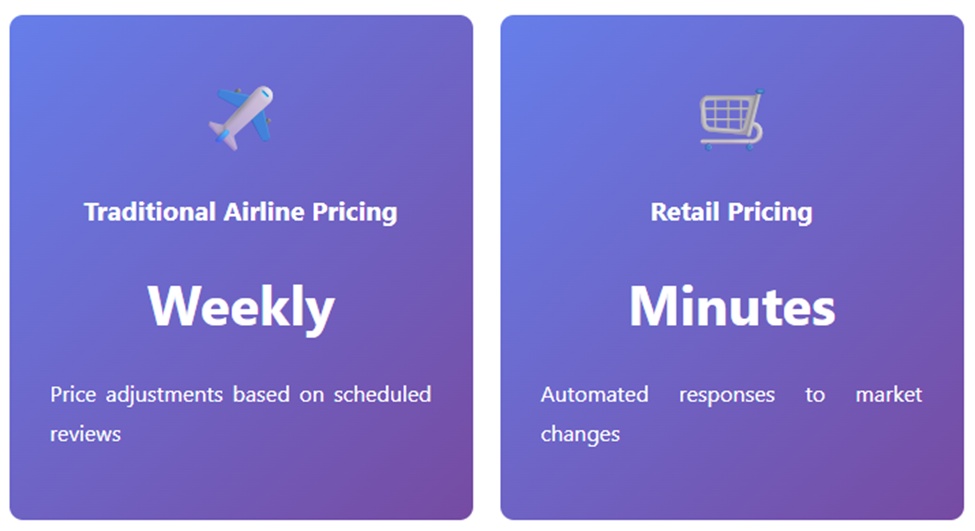
Airlines, by contrast, often operate on slower cycles. While many carriers have improved their pricing agility, the traditional approach involves scheduled pricing reviews, fare filing processes, and distribution system updates that can take hours or even days to fully implement. In an era where hotel prices update continuously and rideshare prices adjust every few minutes, this latency creates competitive vulnerability.
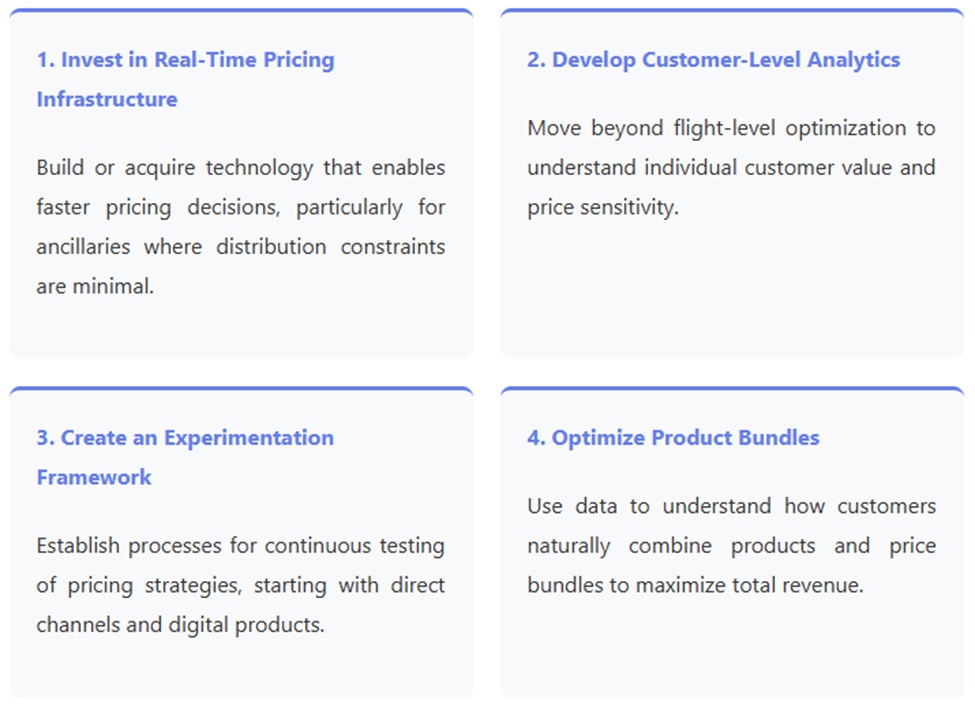
The lesson here isn’t simply to update prices more frequently—it’s to build systems that can sense market changes and respond intelligently without human intervention. Retail pricing platforms use machine learning to detect patterns like coordinated competitor price moves, sudden demand shifts, or inventory imbalances, then automatically execute predefined pricing strategies. Airlines can adopt similar approaches, particularly for ancillary products where the traditional fare filing constraints don’t apply.
Leading retailers don’t just segment by product—they segment by customer lifetime value, purchase frequency, basket size, channel preference, and dozens of other behavioral signals. This enables them to offer differentiated experiences and pricing that maximize both conversion and long-term loyalty.
Consider how Amazon approaches pricing. The company doesn’t just look at whether you’re searching for a specific product—it considers your browsing history, purchase patterns, Prime membership status, and even the time of day you typically shop. This creates a nuanced understanding of price sensitivity and willingness to pay that goes far beyond demographic data.
Airlines are beginning to adopt similar thinking through their loyalty programs and NDC capabilities, but there’s room to go deeper. Imagine pricing strategies that consider not just the current trip but the customer’s annual travel spend, their ancillary attachment rates, their likelihood to book premium cabins on certain routes, and their responsiveness to promotional offers. This level of customer intelligence exists in airline data warehouses—it just needs to be operationalized in pricing decisions.
Retail pricing teams live in a world of constant experimentation. A/B tests run continuously, measuring the impact of price points, promotional messaging, discount depths, and offer presentation. This testing culture generates institutional knowledge about what works, building a library of insights that informs future decisions.
Airlines, historically constrained by distribution channel limitations and the need for fare filing, have found experimentation more challenging. However, the rise of direct channels and NDC technology has removed many of these barriers. Now airlines can test different ancillary pricing strategies, bundle configurations, and promotional approaches with the same rigor that retail companies apply.
Retailers excel at understanding how products relate to each other. They know that customers who buy product A are likely to need product B, and they price accordingly. They optimize bundles not just for margin but for basket size, conversion rate, and customer satisfaction. This cross-product intelligence drives sophisticated promotional strategies that airlines are only beginning to explore.
Airlines have natural product relationships—seats, bags, seats selection, meals, lounge access, ground transportation—but often price these elements independently. Retail pricing teams would approach this differently, using data to understand how customers bundle products and optimizing prices to encourage higher-value combinations. They would test bundle pricing against a la carte, measure the impact on total ancillary revenue, and continuously refine their approach based on results.
The airline industry’s legacy in revenue management remains a significant strength. The sophisticated forecasting models, optimization algorithms, and capacity management techniques that airlines have developed over decades continue to drive billions in incremental revenue. The opportunity isn’t to replace these capabilities but to augment them with lessons from retail pricing.
This means building more agile pricing systems that can respond in real-time to market changes. It means developing deeper customer intelligence that informs personalized pricing and offers. It means embracing experimentation as a core competency, not an occasional activity. And it means thinking holistically about product relationships and bundle optimization in ways that retail teams have mastered.
The airlines that successfully bridge this gap—combining their deep revenue management expertise with retail-inspired pricing capabilities—will be better positioned to maximize revenue in an increasingly dynamic and competitive marketplace. The question isn’t whether to learn from retail pricing teams, but how quickly these lessons can be integrated into airline revenue management practice.