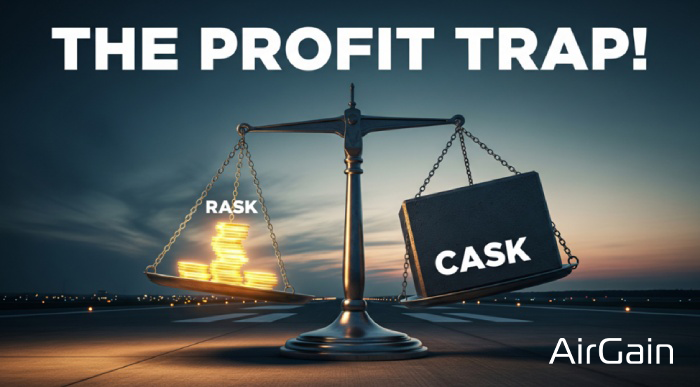
High revenue doesn’t always mean high profit. If that sounds obvious, why do so many airlines keep learning it the hard way?
Some carriers see RASK (Revenue per Available Seat Kilometer) rise steadily. They price well, fill planes, and boost ancillaries—yet profits remain elusive. Or worse, losses deepen.
More often than not, the reason is simple: CASK (Cost per Available Seat Kilometer) is creeping up faster than anyone notices.
RASK vs CASK: The Margin that Matters
These are the two unit economics metrics airlines live or die by:
RASK = Revenue per Available Seat Kilometer
CASK = Cost per Available Seat Kilometer
Together, they define your unit margin—your profit or loss per seat-kilometer.
RASK > CASK = Profit RASK < CASK = Loss
But here’s the thing: Airlines often focus way more on the RASK side of the equation—because it’s visible, exciting, and tied to commercial wins.
Why a Strong RASK Can Be Misleading
Let’s walk through a simplified example:
Airline A improves pricing, adds high-yield routes, and boosts ancillaries. Their RASK rises from $0.070 to $0.075.
But in the same period, fuel prices rise, crew wages go up, and some aircraft go underutilized. Their CASK creeps from $0.068 to $0.078.
Now they’re losing $0.003 per seat-kilometer—despite solid revenue growth.
Multiply that over 2 billion ASKs, and you’re looking at a $6 million monthly loss.
This is how airlines with seemingly strong commercial performance quietly bleed cash.
Full-Service Carriers Are Especially at Risk
Full-service airlines often bank on high RASK to offset their high cost structures. They operate premium cabins, long-haul routes, lounges, loyalty programs—all of which add CASK.
But this model breaks down fast when:
Demand softens
Competition intensifies
Fuel prices surge
Ancillary revenue stalls
High RASK can’t always outpace rising CASK.
That’s why even well-known global brands have struggled while LCCs with tighter cost control stayed profitable.
And because these don’t spike overnight, they rarely get the urgent attention that revenue trends do.
What Low-Cost Carriers Get Right
LCCs aren’t trying to out-RASK anyone. They live and die by CASK discipline:
IndiGo keeps a single-type fleet for simplicity and cost control.
Ryanair squeezes asset utilization and ops costs like a factory.
Wizz Air is known for pruning unprofitable routes without hesitation.
These airlines don’t chase yield. They control spend. That’s what keeps them profitable even when demand is volatile.
So What Can Airlines Do About It?
Here’s how to rethink the RASK obsession:
1. Monitor Contribution Margins at Route Level
Don’t rely on average RASK/CASK. Drill down to see which routes are profitable per seat-kilometer, not just which bring in top-line revenue.
2. Review Channel Economics
Revenue is great. But what does it cost to earn it? Channels with high commission or refund rates can kill contribution.
3. Build Pricing Strategy With Cost Visibility
Stop thinking about yield alone. Instead, model how pricing decisions affect unit margin after CASK.
4. Challenge Sacred Cows
Every airline has “flagship” routes or projects that are emotionally important but financially draining. Be willing to reassess them.
5. Benchmark Smarter
Global averages don’t help. You need relevant peers operating similar routes with comparable costs. Internal benchmarks are better than public ones.
RASK Is Your Offense. CASK Is Your Defense. Margin Wins the Game.
Airlines obsess over revenue because it’s exciting. But ask any CFO—cost kills you faster than soft demand ever will.
RASK gets the headlines. CASK keeps you in business.
In today’s environment, where fuel, wages, and inflation hit hard, the smartest airlines aren’t the ones chasing higher yields—they’re the ones managing every cent of what it takes to fly a seat.
Join the Conversation
Which side of the equation do you think airlines under-manage the most—revenue or cost?
Have you seen cases where high RASK masked deeper structural issues?
Drop a comment or share your experience. Let’s stop treating RASK as a victory lap and start asking the harder question:
“Are we flying profitably—one seat-kilometer at a time?”